
I'm doing this part before Marvel because, quite frankly, if I didn't a lot of people might never take a look at it.
Charlton Comics was the poor relation of the Marvel-DC war (sort of the DuMont network of comix). They did a lot of the standard late-1950s stuff like monster stories, watered-down EC-type stories, hot rods, cowboys, and romance, but they also had some really interesting SF and superhero books, as well as some significant talent. Dick Giordano, who later came over to DC and paired with Neal Adams on a lot of classic Batman stories, as well as with Dick Dillin on Justice League, was first at Charlton. Jim Aparo, who took over the pencils on Brave & Bold from Adams, as well as doing Phantom Stranger, got his start at Charlton as well. Giordano edited, Steve Skeates wrote, and Aparo illustrated one of the better back-of-the-book series, Thane of Bagarth, which ran second fiddle to Sam Glanzman's rather crude Hercules.
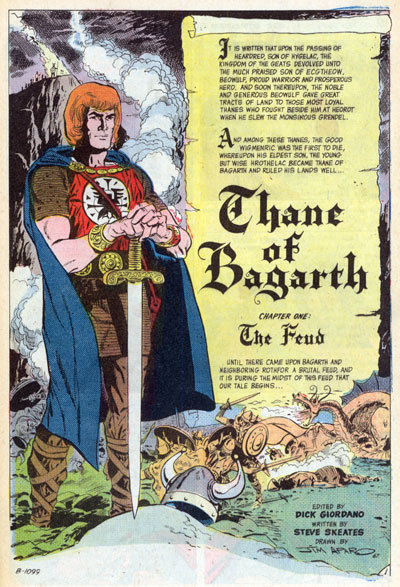
Aparo never got a cover for Thane as far as I know, but the original splash panel will do as a monument to a really nice effort:
I also used to have a real soft spot for a lot of the hot rod comics from Charleton. My brother bought them, but I read them again and again. Mostly short morality plays (favorite theme: the "bad" kid saved by working on a car), but interesting in that a lot of the stories in Hot Rods and Racing Cars were done by Jack Keller, who penciled Marvel's Kid Colt for many, many years. His recurring star was Clint Curtis of the Road Knights.
Here's a representative sample:

But the real reason to read Charlton was Pat Boyette. Boyette got into the business fairly late in life, at age 43, and had a pretty fascinating life:
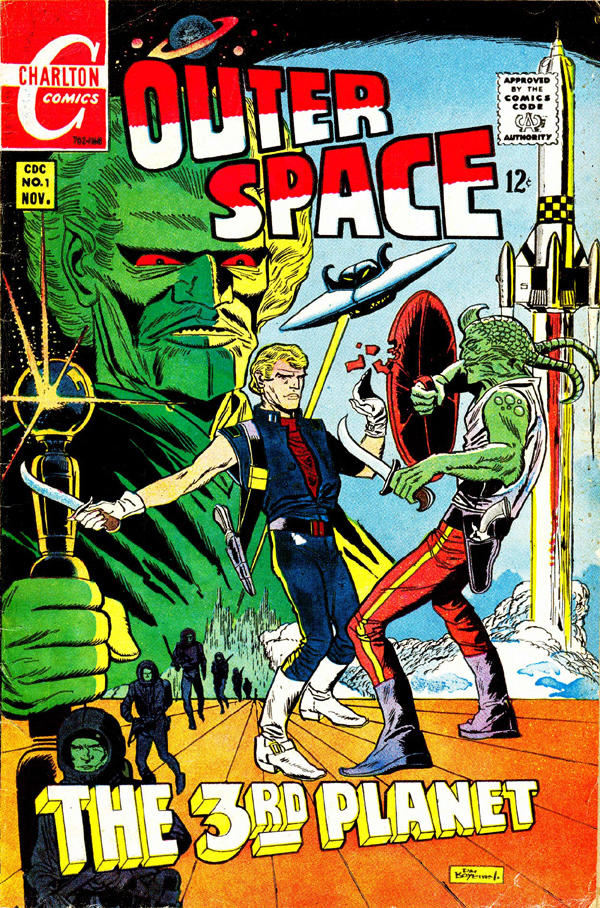
He was very much a stylist, with a kind of stop action technique and an eye for ornate detail. He did outstanding work of some Charlton SF shorts, five issues of Flash Gordon, and with his own creation, the Peacemaker. What I realized as I was looking back at his work for this post is that I really wish, somewhere along the line, he had gotten the opportunity to do the graphics for some Jack Vance novels. I think he would have been perfect.
I can't resist several Boyette images here:


He also did a short stint on DC's Blackhawk:

An aside just for Hube and others interested in the upcoming Watchmen movie before we leave Charlton. Monster vs Bigger Monster explains that Alan Moore based all of his characters on old Charlton Comics superheroes.
Steve Ditko's The Question became Rohrshach
Thunderbolt was warped into Ozymandias
Boyette's Peacemaker was the basis for The Comedian
Ditko's Nightshade became Silk Spectre
The original "Charlton" Captain Atom turned into Dr Manhattan
and The Blue Beetle turned into Nightowl
Gold Key did a number of really neat little books that never really competed well against the Marvel or DC universe, but which did attract a fan following that has remained intensely loyal.
Here were my personal favorites.
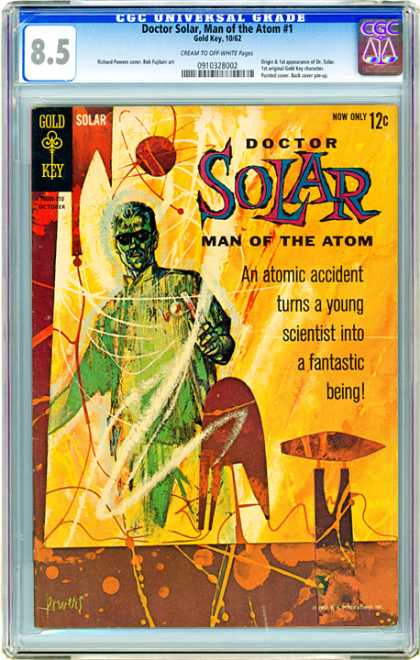
Doctor Solar, Man of the Atom
Magnus, Robot Fighter

Space Family Robinson (I loved the aliens in this issue; look closely at that cover!)

And, my sentimental favorite, Turok, Son of Stone

Gold Key also did a number of television tie-in books, including a workman-like Tarzan and The Man from UNCLE (which was well plotted but so poorly drawn that you could never really recognize Robert Vaughn or David McCallum in the pictures).
Archie attempted a brief foray into superheroes in the early 1960s with Mighty Comics Group, which featured Superman co-creator Jerry Siegel attempting to out-Marvel Marvel, following an earlier, virtually unknown attempt by Joe Simon and Jack Kirby to revive the Shield for Archie Adventure Comics.
I remember two titles most fondly. The Jaguar was one, even though I could never figure out exactly why his affinity with the jungle cat gave him his ability to fly. The attraction must have been either the goofy robots he fought, or the well-dressed 1950s-style working girl babe (frilly blouse, high heels, and gloves for God's sake):

Then there was the inevitable super-group, the Mighty Crusaders, who originally included the Shield, the Fly(man), Fly Girl, Black Hood, and the Comet--all of which were resurrected from the original MCG characters of the 1940s. The scripts were pedestrian, but issue number four is a minor classic. "Too Many Superheroes" brought back virtually every MCG character from the 1940s except Red Rube, Super Duck, and Mr Satan:

I wish I still had that one.
I have obviously broken the rule of five best that I used yesterday, primarily because there is an entire generation of comic readers out there today who really have no idea about the richness of the genre in the 1960s and 1970s before Marvel and DC literally ate everything else.
Marvel favorites will follow in a day or so (I'm traveling tomorrow), but until then, one last image. This is one of the lamest re-imaginings of Captain Marvel every produced, the hero who could take his body apart by yelling, "SPLIT!" and re-assemble it by shouting "XAM!" (cribbed from SHAZAM). What's interesting is that it was one of the last creations of artist Carlos Burgos, whose entire career was pretty much hack work except for that one moment of inspiration in 1940 when he created the Human Torch.
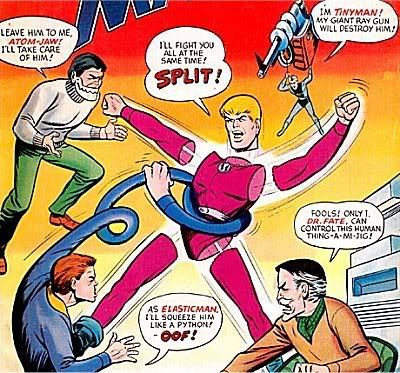
Some things are soo bad they become classics.
Charlton Comics was the poor relation of the Marvel-DC war (sort of the DuMont network of comix). They did a lot of the standard late-1950s stuff like monster stories, watered-down EC-type stories, hot rods, cowboys, and romance, but they also had some really interesting SF and superhero books, as well as some significant talent. Dick Giordano, who later came over to DC and paired with Neal Adams on a lot of classic Batman stories, as well as with Dick Dillin on Justice League, was first at Charlton. Jim Aparo, who took over the pencils on Brave & Bold from Adams, as well as doing Phantom Stranger, got his start at Charlton as well. Giordano edited, Steve Skeates wrote, and Aparo illustrated one of the better back-of-the-book series, Thane of Bagarth, which ran second fiddle to Sam Glanzman's rather crude Hercules.
Aparo never got a cover for Thane as far as I know, but the original splash panel will do as a monument to a really nice effort:
I also used to have a real soft spot for a lot of the hot rod comics from Charleton. My brother bought them, but I read them again and again. Mostly short morality plays (favorite theme: the "bad" kid saved by working on a car), but interesting in that a lot of the stories in Hot Rods and Racing Cars were done by Jack Keller, who penciled Marvel's Kid Colt for many, many years. His recurring star was Clint Curtis of the Road Knights.
Here's a representative sample:
But the real reason to read Charlton was Pat Boyette. Boyette got into the business fairly late in life, at age 43, and had a pretty fascinating life:
Pat Boyette was a notable artist of horror and war stories for mainly Charlton. He was already in his 40s when he began working in comic books, however. Boyette started out working at the radio as a local soap opera actor. He eventually became a broadcast newsman, and during World War II, he worked as a cryptographer. After the War, he turned to television, becoming a TV news anchorman in San Antonio. He also produced a daytime talk show, a puppet show and TV commercials. In the mid-1950s, he briefly drew the syndicated newspaper strip 'Captain Flame'.
He was very much a stylist, with a kind of stop action technique and an eye for ornate detail. He did outstanding work of some Charlton SF shorts, five issues of Flash Gordon, and with his own creation, the Peacemaker. What I realized as I was looking back at his work for this post is that I really wish, somewhere along the line, he had gotten the opportunity to do the graphics for some Jack Vance novels. I think he would have been perfect.
I can't resist several Boyette images here:
He also did a short stint on DC's Blackhawk:
An aside just for Hube and others interested in the upcoming Watchmen movie before we leave Charlton. Monster vs Bigger Monster explains that Alan Moore based all of his characters on old Charlton Comics superheroes.
Steve Ditko's The Question became Rohrshach
Thunderbolt was warped into Ozymandias
Boyette's Peacemaker was the basis for The Comedian
Ditko's Nightshade became Silk Spectre
The original "Charlton" Captain Atom turned into Dr Manhattan
and The Blue Beetle turned into Nightowl
Gold Key did a number of really neat little books that never really competed well against the Marvel or DC universe, but which did attract a fan following that has remained intensely loyal.
Here were my personal favorites.
Doctor Solar, Man of the Atom
Magnus, Robot Fighter
Space Family Robinson (I loved the aliens in this issue; look closely at that cover!)
And, my sentimental favorite, Turok, Son of Stone
Gold Key also did a number of television tie-in books, including a workman-like Tarzan and The Man from UNCLE (which was well plotted but so poorly drawn that you could never really recognize Robert Vaughn or David McCallum in the pictures).
Archie attempted a brief foray into superheroes in the early 1960s with Mighty Comics Group, which featured Superman co-creator Jerry Siegel attempting to out-Marvel Marvel, following an earlier, virtually unknown attempt by Joe Simon and Jack Kirby to revive the Shield for Archie Adventure Comics.
I remember two titles most fondly. The Jaguar was one, even though I could never figure out exactly why his affinity with the jungle cat gave him his ability to fly. The attraction must have been either the goofy robots he fought, or the well-dressed 1950s-style working girl babe (frilly blouse, high heels, and gloves for God's sake):
Then there was the inevitable super-group, the Mighty Crusaders, who originally included the Shield, the Fly(man), Fly Girl, Black Hood, and the Comet--all of which were resurrected from the original MCG characters of the 1940s. The scripts were pedestrian, but issue number four is a minor classic. "Too Many Superheroes" brought back virtually every MCG character from the 1940s except Red Rube, Super Duck, and Mr Satan:
I wish I still had that one.
I have obviously broken the rule of five best that I used yesterday, primarily because there is an entire generation of comic readers out there today who really have no idea about the richness of the genre in the 1960s and 1970s before Marvel and DC literally ate everything else.
Marvel favorites will follow in a day or so (I'm traveling tomorrow), but until then, one last image. This is one of the lamest re-imaginings of Captain Marvel every produced, the hero who could take his body apart by yelling, "SPLIT!" and re-assemble it by shouting "XAM!" (cribbed from SHAZAM). What's interesting is that it was one of the last creations of artist Carlos Burgos, whose entire career was pretty much hack work except for that one moment of inspiration in 1940 when he created the Human Torch.
Some things are soo bad they become classics.
Comments
http://en.wikipedia.org/wiki/T.H.U.N.D.E.R._Agents