
.... and why they are not a good bet, energy wise.
It is a wonkish post of the kind I was one day planning to write, and now don't have to, because Coyote Blog has pretty much retired the fantasy that urban commuter light rail systems would be better than hybrids or more efficient automobiles.
I particularly like his opening salvo:
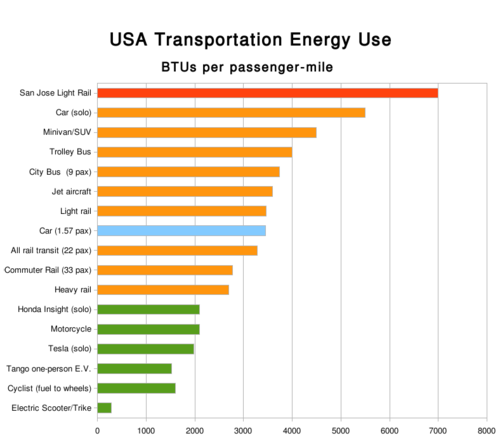
The only refutation I can think of, regarding the analysis that follows this graphic, is a country in which the government so prohibitively taxed all urban automobiles that it would force greater ridership (I can hear my progressive friends salivating now). The problem with that, of course [aside from the obvious Statist implications] is that no matter how manner riders you have, your carrying capacity has to be figured based on your peak hours, which necessitates that your average will continue to be slightly less than half your peak ridership. Do the math.
So, no matter what, the energy cost ratios of light rail will always disappoint the unrealistic expectations of the advocates.
That won't, however, stop them from sticking their hands in your pocket and feeling about for (we hope) spare change.
It is a wonkish post of the kind I was one day planning to write, and now don't have to, because Coyote Blog has pretty much retired the fantasy that urban commuter light rail systems would be better than hybrids or more efficient automobiles.
I particularly like his opening salvo:
I generally have a bet I make for new light (and heavy) commuter rail systems. I bet that for the amount the system cost to build, every single daily rider could have instead been given a Prius to drive for the same money; and, with the operating losses and/or subsidy the system requires each year, every one of those Prius drivers could be given enough gas to make their daily commute. And still have money left over. I have tested this bet for the systems in Los Angeles and Albuquerque.
Well, it turns out I left something out. Many people are interested in commuter rail because it is perceived to be greener, which nowadays generally means narrowly that it uses less energy and thus produces less CO2. But in fact, it may not. Blogger John Moore sent me a link to this article by Brad Templeton analyzing energy usage in various transportation modes. While a full train can be fairly efficient (just as a full SUV could be if 7 passengers were in it), cars and trains and busses are seldom full. When you look at their average load factors, trains are seldom better than cars:
The only refutation I can think of, regarding the analysis that follows this graphic, is a country in which the government so prohibitively taxed all urban automobiles that it would force greater ridership (I can hear my progressive friends salivating now). The problem with that, of course [aside from the obvious Statist implications] is that no matter how manner riders you have, your carrying capacity has to be figured based on your peak hours, which necessitates that your average will continue to be slightly less than half your peak ridership. Do the math.
So, no matter what, the energy cost ratios of light rail will always disappoint the unrealistic expectations of the advocates.
That won't, however, stop them from sticking their hands in your pocket and feeling about for (we hope) spare change.
Comments
However it does have one slight advantage that often causes me to use it if I do have to go into the city - namely it can be incredibly difficult to PARK a private car in the city, and light rail / mass transit DOES offer the slight advantage of moving the parking areas out of the crowded downtown areas to the more suburban ends of the system... It's still expensive to park, but the hassle factor of parking is less...
ART
Your point is well taken but full of its own holes. It is this sort of argument which portrays Libertarianism, sometimes, as merely an effort to twist the system to the speaking individual's personal preferences, the ways of life of everyone else be damned.
Just saying. (All in all, fascinating blog - keep up the good work!)
The point you miss is this: ALL transportation (or public policy) proposals are ALWAYS full of externalities that can be debated back and forth. So what? You value having government-subsidized transport options available for those who choose not to own a car--I don't. You ignore the gigantic construction and maintenance externalities of a light rail system, while choosing to point out congestion problems with cars. That's why we have a debate (fyi a Prius produces very very little CO2 while not moving).
What you conveniently slide by, however, is that the primary argument always made to support such highly subsidized mass transit systems is that they are more energy efficient. It turns out that the answer to that is not at all clear cut, and the difference is probably so close that it always comes down to the specifics of the locality to determine it. Once that's taken away, you're then down to arguing subsidiary arguments.
That's not me twisting things.